
Nepal’s vulnerability to disasters is shaped by its geography, climate, and socio‑economic conditions. The country ranks fourth globally in earthquake risk and eleventh in climate change vulnerability. Each year, around 500 disaster events occur, including floods, landslides, fires, and epidemics. These recurring hazards disrupt lives and development, making disaster risk management (DRM) a national priority.
Evolution of Legal Frameworks
Disaster governance in Nepal began with the Natural Calamity Relief Act of 1982, which focused mainly on relief and response. While it provided a legal foundation for emergency action, it lacked provisions for preparedness and mitigation. A major milestone came with the Disaster Risk Reduction and Management Act of 2017, which replaced the earlier law. This Act expanded the scope to cover preparedness, response, rehabilitation, and mitigation, marking a turning point in Nepal’s disaster governance.
Other sectoral laws also contribute to DRM. The Soil and Watershed Conservation Act (1982), Water Resource Act (1992), Forest Act (1993), Building Act (1998), and Environment Protection Act (1996) all contain provisions relevant to disaster management. However, conflicts between national legislation and local governance provisions—such as between the Water Resource Act and the Local Government Operation Act of 2017—have created challenges in enforcement and coherence.
Policies and Programs
Nepal’s policy journey reflects gradual progress. The National Action Plan of 1996 introduced hazard mapping and preparedness measures. Later, sectoral policies such as the Forestry Sector Policy (2000), Water Resources Strategy (2002), and National Water Plan (2005) addressed water‑induced disasters. In 2009, Nepal adopted the National Strategy for Disaster Risk Management, aligning with the global Hyogo Framework for Action. More recently, Nepal has embraced the Sendai Framework for Disaster Risk Reduction (2015–2030), which emphasizes resilience and proactive risk reduction.
Disaster management has also been integrated into national development plans since the Tenth Plan (2002–2007). Despite these advances, policies often emphasize preparedness and response, while rehabilitation and mitigation receive less attention.
Institutional Structures
Institutional arrangements have expanded significantly. The National Council for Disaster Risk Reduction and Management (NCDRRM), chaired by the Prime Minister, provides high‑level leadership. The National Disaster Risk Reduction and Management Authority (NDRRMA), under the Ministry of Home Affairs, serves as the focal agency for disaster governance. At provincial, district, and local levels, disaster management committees have been established to implement policies and coordinate response. Their responsibilities include search and rescue, relief distribution, hazard mapping, and early warning systems.
These institutions represent important progress, but their effectiveness depends on coordination, resources, and community engagement.
Gaps and Constraints
Despite progress, several gaps persist. Disaster governance is often over‑centralized, limiting the role of local governments in policy‑making. Conflicts between laws and ministries create institutional incoherence. Community awareness and preparedness remain weak, as seen during the Seti flood of 2012. Rehabilitation and mitigation receive less attention compared to immediate response, while regional disasters such as the Koshi flood (2008) and Jure landslide (2014) highlight the need for cross‑border cooperation.
The Way Forward
The 2017 Act marked a turning point in Nepal’s disaster governance, but implementation challenges remain. To build resilience, Nepal must strengthen coordination across ministries, local governments, and communities. Greater emphasis should be placed on rehabilitation, mitigation, and proactive risk reduction rather than reactive response. Institutional capacity needs to be enhanced, and community awareness programs expanded to ensure preparedness at the grassroots level. Finally, regional cooperation is essential, as many disasters transcend borders and require joint action.
Nepal’s path forward lies in translating laws and policies into effective action that protects lives and sustains development.
This article is based on:
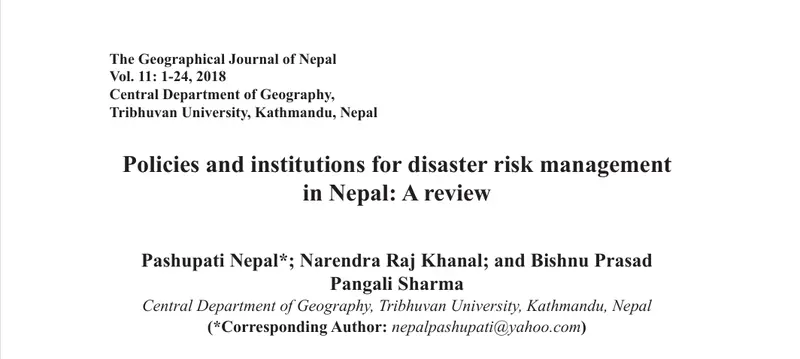
- Nepal, Pashupati; Khanal, Narendra Raj; Sharma, Bishnu Prasad Pangali (2018). “Policies and Institutions for Disaster Risk Management in Nepal: A Review.” Geographical Journal of Nepal, Vol. 11.
- Key institutional reference: National Disaster Risk Reduction and Management Authority (NDRRMA), Government of Nepal.
🔗 Full paper: Policies and Institutions for Disaster Risk Management in Nepal: A Review