
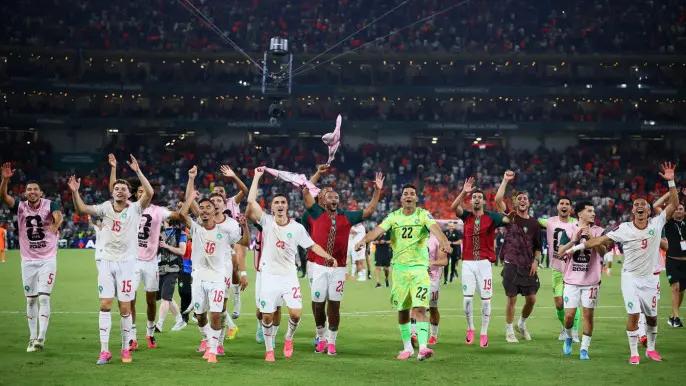
Morocco Deliver a Statement Win
Morocco produced a defining World Cup knockout performance, beating the Netherlands 3-2 on penalties after a 1-1 draw over 120 minutes at Estadio Monterrey. This was not a lucky escape or a chaotic smash-and-grab. Morocco dictated large stretches of the match, absorbed pressure with discipline, and handled the shootout with far greater calm when it mattered most. For the Netherlands, it was another painful exit built on control without enough end product.
First-Half Tension
The opening half was tight, physical, and tactically compressed, with neither side finding much room between the lines. Morocco were the more adventurous team in the bigger moments, while the Netherlands stayed cautious and tried to keep the game under control. The tempo never really exploded, but the match already had the feel of a contest that would be decided by one flash of quality or one mistake.
That flash came close to arriving through Morocco before halftime. The match remained scoreless at the break, but the underlying pattern was already clear: Morocco were comfortable asking questions, and the Dutch were more interested in avoiding risk than forcing the issue. In a knockout game, that kind of caution can become dangerous if it invites the opponent to grow in confidence.
Gakpo Breaks Through
The Netherlands finally found a breakthrough in the 72nd minute when a long goal kick and a flick header from Wout Weghorst released Crysencio Summerville, who then set up Cody Gakpo for a clean finish. It was a sharp, direct Dutch move, and for a moment it looked like it might be enough to settle the tie. Gakpo’s goal also carried emotional weight, and his reaction after scoring added a deeply human layer to the night.
But the lead did not last. Morocco kept pushing, and their persistence paid off in stoppage time when Cheick Talbi’s delivery found Issa Diop, who powered in the equalizer at 90+1. That goal changed everything. Instead of a Dutch victory, the match slid into extra time, and the momentum had clearly shifted toward Morocco.
Extra Time and Pressure
Extra time brought more tension than quality, but the best chances still leaned Morocco’s way. One of the defining moments came when Soufiane Rahimi broke through one-on-one, only for Bart Verbruggen to produce a crucial save that temporarily kept the Netherlands alive. That stop mattered, but it also hinted at the larger problem for the Dutch: they were hanging on rather than imposing themselves.
The Netherlands had the ball for long stretches, yet Morocco looked more likely to land the decisive blow. Ronald Koeman’s side never found a consistent attacking rhythm, and their conservative structure became more vulnerable as the match wore on. By the end of extra time, the tie felt less like a Dutch control game and more like a Moroccan endurance test that they were increasingly winning.
Shootout Decisiveness
The penalty shootout was chaotic and unforgiving. Morocco and the Netherlands each missed multiple kicks, and the sequence became a test of nerve as much as technique. Justin Kluivert missed for the Dutch, while Quinten Timber and Crysencio Summerville also failed to convert, leaving too much pressure on the rest of the lineup.
Yassine Bounou stood tall when it mattered and helped tilt the contest Morocco’s way. On the final decisive kick, Ismael Saibari stepped up and converted, sending Morocco into the last 16 and the Dutch out of the tournament. In knockout football, penalty shootouts often reduce everything to nerve, and Morocco were simply better prepared for the moment.
Tactical Picture
Morocco’s biggest strength was not one player or one phase of play. It was the collective refusal to break under pressure. They remained organized, stayed patient, and continued to find ways to threaten even when the Netherlands held the ball. That balance between control and urgency is what made them so dangerous.
The Netherlands, meanwhile, were heavily criticized for becoming too passive after taking the lead. Their back-five approach invited Morocco forward instead of stamping authority on the game. When a team of Morocco’s quality senses hesitation, it can turn the match into a siege — and that is exactly what happened here.
What the Result Means
This result sends Morocco into the Round of 16 with real momentum and growing belief. They have shown they can survive a major knockout pressure cooker, handle emotional swings, and win on penalties against a major European side. That is the profile of a team no one will want to meet in the next round.
For the Netherlands, the defeat will trigger serious questions about game management and attacking ambition. They controlled the ball without controlling the outcome, and that is often the most painful way to exit a World Cup. Morocco earned this one through discipline, bravery, and composure, the traits that separate contenders from survivors.