
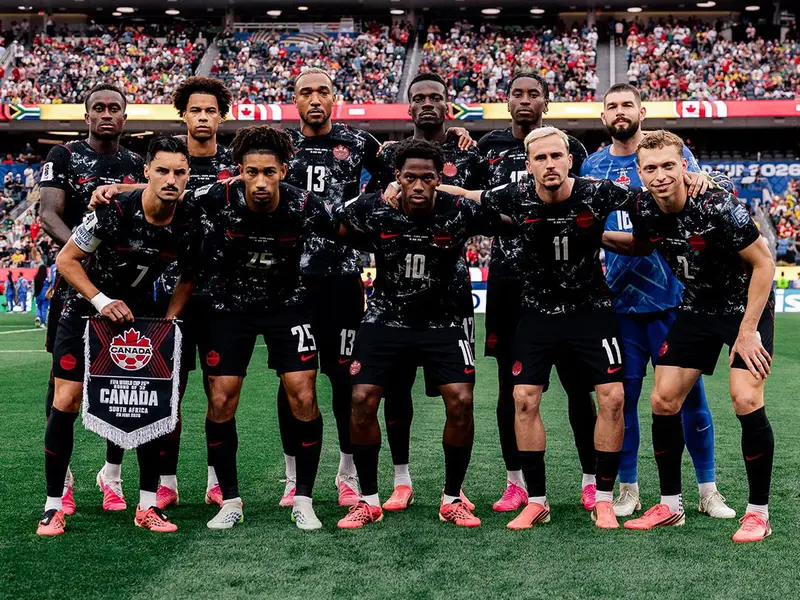
Canada’s rise in football is one of the most compelling stories in the sport right now. A country long associated with hockey has turned soccer into a genuine national movement, and the timing could not be better with the 2026 FIFA World Cup on home soil. Canada’s men are no longer outsiders; they are a team with real tournament relevance, real talent, and real expectations.inside.
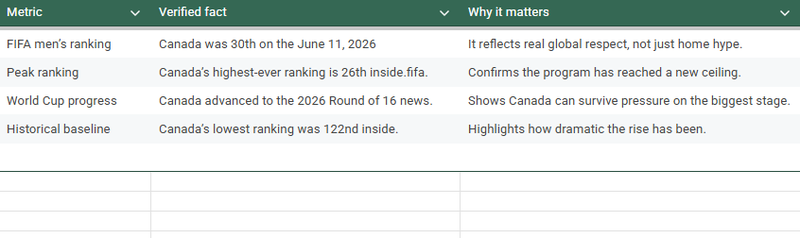
The hard numbers tell the story. FIFA’s live ranking page showed Canada at 30th in the world on the June 11, 2026 official update, with a highest-ever ranking of 26th and a lowest point of 122nd. On the pitch, Canada has already made history in 2026 by reaching the Round of 16 at its home World Cup, a breakthrough that signals a massive step forward in competitive status.
The historical climb
Canada’s football identity has changed in stages, not overnight. The men’s national team first reached the World Cup in 1986, then waited 36 years to return in 2022, and both appearances ended in the group stage. That gap created a long period where football mattered deeply in immigrant communities, youth leagues, and pockets of urban Canada, but not yet as a dominant national sporting force.
The modern shift began when Canada developed a generation with top-level European experience and a more assertive competitive identity. FIFA’s history page now lists Canada’s men with two World Cup appearances before the 2026 tournament, and the country’s live ranking profile shows a clear upward arc from a low of 122nd to a peak of 26th. That kind of climb usually happens only when talent, structure, and ambition finally align.
Why the rise happened
The biggest reason for Canada’s football rise is talent concentration at the top. Alphonso Davies, Jonathan David, and a deeper supporting cast gave Canada a real spine, not just a few promising names, and that matters in international football where margins are tiny. Once a team has genuine match-winners, belief spreads through the whole program.
The second driver is infrastructure and visibility. FIFA’s official association page now frames Canada inside a wider development story, while Statistics Canada shows soccer is widely played across the country and especially popular in immigrant communities. Add the 2026 World Cup’s home spotlight and you get something bigger than a tournament run: you get a culture shift.
How Canada progressed
Canada’s progress on the world stage can be measured in three layers. First, it moved from sporadic qualifying success to regular competitive relevance in Concacaf, eventually returning to the World Cup in 2022 after decades away. Second, it proved it could produce players who belong in elite leagues, which raises the level of every camp, every window, and every game plan.
Third, it started converting exposure into results. Canada’s 2026 campaign included a 6–0 win over Qatar, its first men’s World Cup victory, followed by a Round of 16 breakthrough that made the team the latest symbol of host-nation ambition. That is the difference between being a feel-good story and being a real football nation: winning, advancing, and forcing the world to update its expectations.
Pitfalls and rumors
There is a temptation to overstate the rise as if it happened purely because Canada hosted the World Cup. That would be too simple, because hosting helps visibility, but ranking gains, player development, and tournament results are what actually move a program. The evidence shows Canada’s rise began well before kickoff and is rooted in real football progress.
Another myth is that one breakthrough run automatically makes Canada a finished product. It does not. The program still needs stable elite infrastructure, more depth beyond its stars, and sustained development for youth and women’s pathways, even as federal support for a national training centre points in the right direction. The real story is not hype; it is momentum.
Future prospects
The prospect for football in Canada is strong because the sport now has scale, stars, and stages. FIFA’s official records show the men’s team has moved from historical obscurity into a live contender with a rising profile, while the women’s program already gives the country proven elite pedigree on the global side. That combination matters: it builds continuity, not just one-off excitement.
Infrastructure is also starting to catch up. Ottawa’s $9.8 million commitment toward a Canada Soccer National Training Centre shows the country is thinking beyond the tournament and into the next cycle of elite development. If Canada keeps turning participation into pathways and pathways into performance, then its football culture will not just grow—it will harden into something lasting.
Canada’s football story is now bigger than surprise; it is about consolidation, ambition, and a country learning to expect more from the sport. Keep watching Canada this is the beginning of a long climb, not the peak.